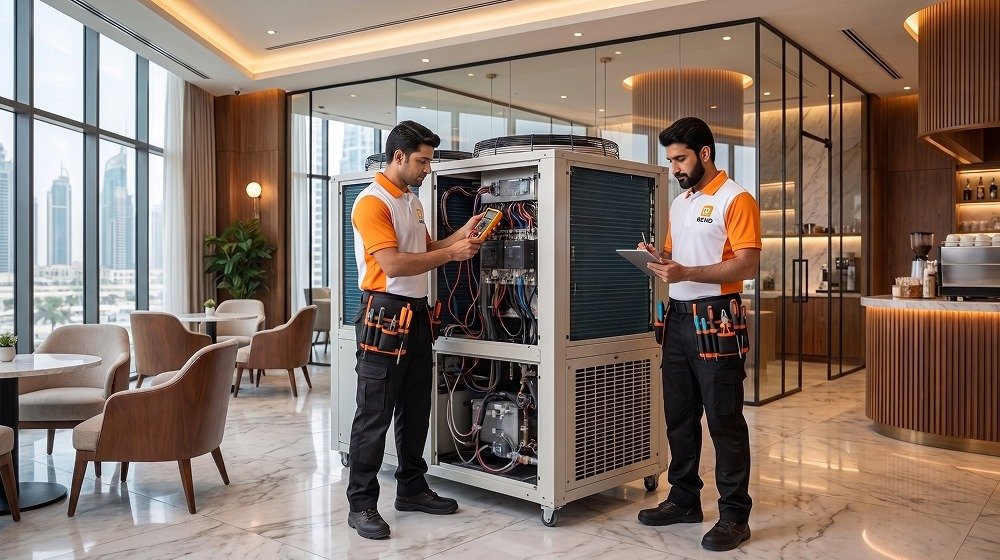
Appliance repair and maintenance are two sides of the same management conversation, and in Dubai they are more closely connected than in most markets. A commercial chiller that is well maintained needs repair less often. A commercial chiller that is poorly maintained needs repair sooner, more expensively, and in conditions, typically the height of a Dubai summer, where the cost of downtime is at its highest. This guide covers both sides of that equation for businesses operating commercial refrigeration in Dubai and across the UAE, giving operators the practical framework to keep their units running reliably and to handle the repairs that eventually become necessary with the right approach.
The Relationship Between Maintenance and Repair Costs in Dubai
The financial case for preventive maintenance on commercial chillers is stronger in Dubai than in most other operating environments, and the numbers behind it are straightforward. A commercial chiller compressor replacement in the UAE typically costs several times more than a full annual maintenance programme for the same unit. A refrigerant recharge following a significant leak costs more than the leak detection and seal repair that would have caught the same fault three months earlier. Emergency call-out rates for commercial chiller repair UAE technicians are higher than scheduled service rates, and the cost of perishable stock lost during an unplanned failure adds a further dimension that scheduled maintenance entirely prevents.
Dubai’s climate is the multiplier that makes this calculation more compelling here than elsewhere. The sustained heat of a UAE summer means that a chiller operating with dirty condenser coils, a marginally low refrigerant charge, or worn compressor components is not merely underperforming. It is actively being damaged by the combination of its own inefficiency and the ambient conditions pushing against it. Every additional week of deferred maintenance in summer is more costly than the same week of deferred maintenance in winter, and the cumulative effect of several summers of inadequate maintenance routinely produces the premature compressor failures that generate the most expensive repair calls.
What a Commercial Chiller Maintenance Programme Should Include
A maintenance programme designed for Dubai’s operating conditions looks different from a standard service schedule produced for a temperate climate, and the differences reflect the specific stresses the environment places on commercial refrigeration systems. The following components represent the minimum effective standard for commercial chiller maintenance Dubai.
Condenser Coil Cleaning
This is the highest-frequency maintenance task and the one with the most direct impact on day-to-day chiller performance in Dubai. Condenser coils release the heat extracted from the chiller’s interior into the surrounding environment, and their ability to do this efficiently depends entirely on unobstructed airflow through the fins. Dubai’s dust accumulates on condenser fins at a rate that reduces airflow efficiency measurably within weeks of a cleaning, not months. Industry practice for commercial chiller maintenance Dubai recommends cleaning every six to eight weeks in the UAE environment rather than the quarterly intervals appropriate for cleaner climates. A chiller with partially blocked condenser coils operates at elevated head pressure, which forces the compressor to work harder than its design specification and accelerates wear across every component in the refrigeration cycle.
Refrigerant Level Checks and Leak Detection
A commercial chiller that is losing refrigerant does not fail suddenly. It fails gradually, with a progressive decline in cooling capacity that can be easily attributed to other causes until the unit can no longer maintain safe temperatures. Biannual refrigerant level checks combined with system pressure testing catch developing leaks before they reach the point of significant refrigerant loss. When a low refrigerant level is identified, the correct response is always to locate and repair the source of the loss before recharging the system. Recharging without repairing delivers a temporary restoration of performance followed by the same fault recurring within months, at the same cost each time.
Door Seal and Gasket Inspection
Door seals on commercial chillers deteriorate faster in Dubai’s heat than in cooler climates. A seal that has hardened, cracked, or deformed no longer creates an airtight closure, allowing warm ambient air to enter the chiller compartment continuously during operation. The compressor compensates by running more frequently to maintain the set temperature, and the cumulative effect of that additional cycling is accelerated wear and higher energy consumption. Monthly visual inspection of door seals, with replacement at the first sign of deterioration rather than waiting for a visible gap, is one of the most cost-effective maintenance actions available for commercial chillers in Dubai.
Electrical and Control System Checks
The electrical components of a commercial chiller, including contactors, capacitors, wiring connections, and control boards, are subject to the heat stress and vibration of continuous operation in Dubai’s ambient conditions. Loose connections that would take years to develop into a fault in a cooler environment can progress to intermittent control failures or component damage within a single season of UAE summer operation. Annual electrical inspection as part of a comprehensive service catches these developing faults before they interrupt operation.
Compressor and Motor Assessment
The compressor is the component whose condition most determines the remaining operational life of a commercial chiller, and its condition can be assessed through a combination of current draw measurement, vibration analysis, and pressure differential testing without requiring disassembly. A compressor drawing significantly more current than its rated specification, producing abnormal vibration, or maintaining a lower than expected pressure differential across the refrigeration cycle is one that is losing capacity and approaching the end of its service life. Identifying this condition during a scheduled assessment allows the repair to be planned and budgeted rather than responded to as an emergency.
When Maintenance Is Not Enough: Commercial Chiller Repair in Dubai
Even a well-maintained commercial chiller will eventually require repair. Component wear, refrigerant system faults, and electrical failures occur in maintained equipment as well as neglected equipment, just less frequently and at more predictable intervals. Knowing how to respond when a repair is genuinely needed is as important as knowing how to maintain the unit effectively.
Faults That Need Immediate Attention
Temperature rising above safe storage limits, visible refrigerant oil staining around connections indicating a significant leak, compressor clicking at startup and failing to run, unusual burning smell from electrical components, and any water pooling inside or beneath the unit.
Faults That Can Be Scheduled
Gradual temperature creep that has not yet reached unsafe levels, minor door seal deterioration identified during inspection, condenser fan noise that is new but not preventing operation, and minor control panel display issues that do not affect the unit’s actual temperature management.
The distinction between immediate and schedulable faults matters for operational planning. An immediate fault requires a same-day commercial chiller repair UAE response and the activation of contingency stock management. A schedulable fault allows time to select the right repair provider, obtain a proper quotation, and arrange the work at a time that minimises disruption to operations.
Choosing a Commercial Chiller Repair and Maintenance Provider in Dubai
The provider you choose for both maintenance and repair has a direct impact on the reliability of your commercial refrigeration and the total cost of ownership over the unit’s operational life. In Dubai’s commercial refrigeration market, the variation in provider quality is significant enough to produce meaningfully different outcomes from the same equipment depending on who is servicing it.
- Verify that the provider holds UAE-applicable refrigerant handling certification before allowing any work on your refrigeration system. Handling refrigerants without certification is a regulatory violation in the UAE and indicates a provider who does not meet minimum professional standards
- Ask for evidence of specific experience with your chiller brand and type. Commercial refrigeration systems from different manufacturers have different diagnostic requirements, and brand familiarity produces faster and more accurate fault identification
- Confirm that the provider uses genuine manufacturer parts or approved equivalents for any components replaced. Aftermarket parts of uncertain quality in a commercial refrigeration system create reliability risks that outweigh any cost saving at the point of repair
- Establish response time guarantees for emergency commercial chiller repair Dubai call-outs before you need them. Finding out a provider’s emergency response time during an actual emergency is the worst possible time to make that discovery
- Request a service agreement that combines scheduled maintenance with priority repair response. A service agreement with the right provider is consistently more cost-effective than managing maintenance and repair separately on an ad-hoc basis
Conclusion
Commercial chiller maintenance in Dubai is the investment that reduces the frequency and cost of commercial chiller repair UAE businesses would otherwise face as an unpredictable and expensive operational liability. The relationship between the two is direct: better maintenance produces fewer repairs, and fewer repairs produce lower total costs and more reliable cold storage operations. In Dubai’s operating environment, where the consequences of chiller failure are amplified by the ambient conditions and the operational stakes of cold storage, this relationship is more financially significant than in most other markets. The framework in this guide gives operators the structure to manage both maintenance and repair effectively and to choose the providers whose expertise makes that management reliable.