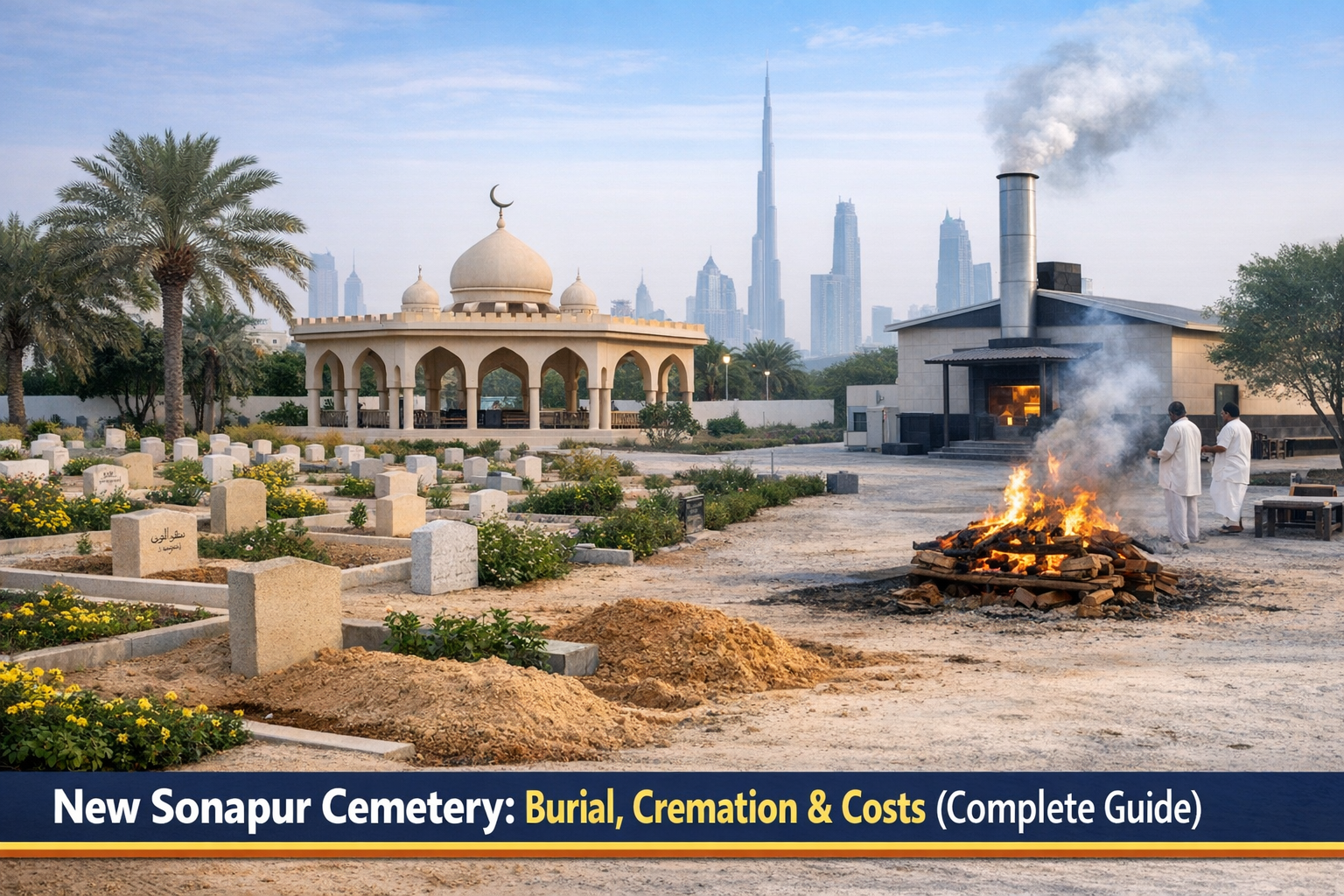
New Sonapur Cemetery is a gigantic graveyard in Dubai, and also it is known as Jebel Ali Cemetery. The municipality of Dubai constructed this graveyard, as the older ones had been filling up. A lot of people were in urgent need of something to bury their loved ones.
Where is New Sonapur Cemetery?
Jebel Ali Industrial Area is where the burial yard is located in Dubai. The concrete postal address is 23/2 First Al Khail Street, Jebel Ali Industrial 3. Travelers can reach this place by going north along the Sheikh Zayed Road towards Abu Dhabi, then taking Exit 6, Jebel Ali Industrial 3.
Since the Sonapur Cemetery is not very near the metro stations, passengers hardly use them as their transport. The nearest metro stops are Al Qusais and Jebel Ali Metro Station, but they are far away. Some buses run on this route, but the majority of people opt for a taxi – that is the easiest way to get to the cemetery. The parking lot, for cars, is spacious at the cemetery.
When is the Cemetery Open?
Currently, the New Sonapur Cemetery premises are unlocked at all times, and people cannot be forbidden from entering. Thus, they are operational 24/7, with the days and nights being the same.
There are certain days of the week (i.e., ‘every day’) and time constraints (from 6:00 in the morning until 9:00 at night) established on the office hours, but otherwise, the working hours of cemeteries are a function of the demand/association of the persons with the deceased.
What Services Does the Cemetery Provide?
Muslim Burials
The bulk of the land is reserved for the burial of Muslims in this New Sonapur Cemetery. Islamic respect is upheld in the end by the people’s sons who are buried Muslims. Rows of graves are very well-arranged and are kept spotless by the cemetery workers. Muslim graves are usually unmarked graves or graves with simple headstones. The latter are followed by Islamic traditions.
Certainly, there are open spaces in the graveyard where the religious minority can practice their own way of worship. The graves are placed in ordered lines and are maintained by the workers whose vigilance ensures that the graves are clean. Some graves are not even marked, and the management wants it that way as a representation of the Islamic tradition of simplicity, more than one with direct connection to it.
Non-Muslim Burials
Besides burying people from religious backgrounds other than Islam, there are also non-Muslims who share who need the permission of the Dubai government. They must liaise with their embassy and get their papers, and there are additional costs. Aside from that, the untouchables may have been seen with their bodies in sacred areas.
Cremation Services
Additionally, the cemetery has a crematorium, which is a special type of building that is used to burn bodies to ashes instead of burying them. This is the only place in the USA where cremation is allowed. Typically, Hindu, Sikh as well as other non-Muslim families utilize the option of this service.
The crematory providing the latest technologies and a large hall for prayer is good enough for Hindu persons to conduct their soul-peaceful practice. A prayer hall is provided to the Hindus, as they can take advantage of it whenever they want. Additionally, the local Indian community helped a lot in funding this building.
After the bonfire is over, families can collect the ashes the next day. Staff at the cemetery help families with all the necessary arrangements and paperwork in case of cremation.
How Much Does It Cost?
“Each person’s financial obligations vary, depending on the services they will use:
- Muslim burials are usually free or very cheap.
- Non-Muslim people who live in Dubai must pay 1,000 dirhams to the Dubai government for non-Muslim funerals.
- Cremation prices are between 1,100 and 2,500 dirhams.
- Christian burials that involve adults cost about 1,100 dirhams, and 350 dirhams for those of children.
Poor families are sometimes given discounts or exemptions if they cannot afford the full amount. The neighborhood leaders have a say in this matter.
Rules for Visitors
There are certain norms governing the cemetery’s visitors:
- Be respectful – Take arms and legs
- As far as the females are concerned, they might have to cover their heads in the prayer halls
- Do not create any noise and be silent
- Pets are not allowed
If you accidentally plug your earphones in too late, you will not be able to take photos during the prayer services. Cemetery staff peeps themselves to the area and mop the floor every day. Security guards help visitors find the right section and keep the area neat all the time.
Other Cemeteries in Dubai
Dubai actually boasts of having some other cemeteries besides the New Sonapur Cemetery:
Al Qusais Cemetery
Among the various traditional Muslim graveyards in the Muhaisnah community, the Al Qusais Cemetery is the oldest one. Its operation span is the period between 6 AM and 6 PM every day. The Muhaisnah Cemetery was the destination for quite a number of Muslim families even during the New Sonapur days.
Dubai Christian Cemetery
The Christian cemetery, which is one of the oldest in Jebel Ali, specifically caters to the Christian community. It is a suburb in Jebel Ali close to the Marina. They train the students in the Christian rite of burial. This facility is a not-for-profit enterprise, and it is maintained by a team of volunteers.
Other Places
Dubai has small resting places at Al Quoz and Hatta. Sharjah is another place where it is possible to find funeral services suitable for the people locally.
Recent News and Updates
The news about the cemetery was repeated many times:
- Dubai Municipality in 2019 charged 1,000 dirhams to non-Muslim funerals.
- 2015 newspapers told the story of a family who had lost their baby half a decade prior, and the death of the child, whose body was laid to rest at the local cemetery.
- In 2026, the body of a famous figure, a photographer, was brought to the cremation place, which is a clear indication that this is not only a service for ordinary folks but also that the rich use it.
See, the Dubai government is still trying to perfect and expand the graveyard, because of the fact that many people are in need of this service, they need the capacity to grow.
Transportation Tips
Not many people can do without a car to get to the cemetery:
- By car: Turn onto Jebel Ali Industrial 3 through the Sheikh Zayed Road as you head towards Abu Dhabi
- By renting cabs: The fastest way to the place is through a taxi, but it could be a little bit expensive
- By buses: A few buses go through the area, i.e., buses 13, 33, and some other routes as well
- By metro: Buy a metro ticket, board the train, and leave at the ‘Jebel station.’
All car drivers can conveniently park their cars in the free parking space.
Why New Sonapur Cemetery is Important
New Sonapur Cemetery serves different services for the city. It is important because of the following factors:
- It is a place where all diverse religious traditions can comfort their bereaved ones through a respectful burial
- Modern space of facilities confirming international standards
- The anticipated problem of excessive overcrowding in the previous cemeteries is also solved to some extent by the cemetery
- A crematorium that accommodates communities that prefer a cremation service to a conventional burial is also available
- Expert personnel who guide kin through the tense times of the death of a loved one
The cemetery, which is constructed by the Dubai authorities, reflects the levels of care and concern they provide to all the citizens of Dubai, despite differences in cultures and religions. The service provided is to assist the family in times of need, with dignity, respect, and professionalism.
FAQ’S
Can Christians be buried in Dubai?
Yeah, Christians can be lain in Dubai Cemetery. It has its own cemetery in Jebel Ali. However, Christian families have to get the Mayor’s permission through a letter of request from their Embassy first then conduct a Christian burial as they want to be.
How much is the crematorium fee in the UAE?
It costs 1,000 dirhams non-Muslim families have to pay when taking their dead bodies to Dubai Municipality which is responsible for the transfer of bodies from the casket to the units in the cremation chamber and their subsequent burial. The cost breakdown is around 1,100 to 2,500 dirhams for the service. Normally poor families might be given some kind of discount if they report incapacity to pay the whole bill.
Is Sonapur a part of Dubai?
Yes, Sonapur is included in Dubai. Actually, Sonapur is another name for Muhaisnah 2 area which is in the eastern part of Dubai, very near the border with the state of Sharjah. The New Sonapur Cemetery is in Dubai, not in Sharjah.
Which documents are needed?
The things that need to be accompanied by the families are the following:
- Certificate of death from a medical doctor
- Documentation of ID (Passport or Emirates ID also if any non-Muslims they have to submit a permission letter from their embassy)
- Police clearance
The cemetery staff is very helpful to the families in understanding the documentation requirements and the process of getting the same.