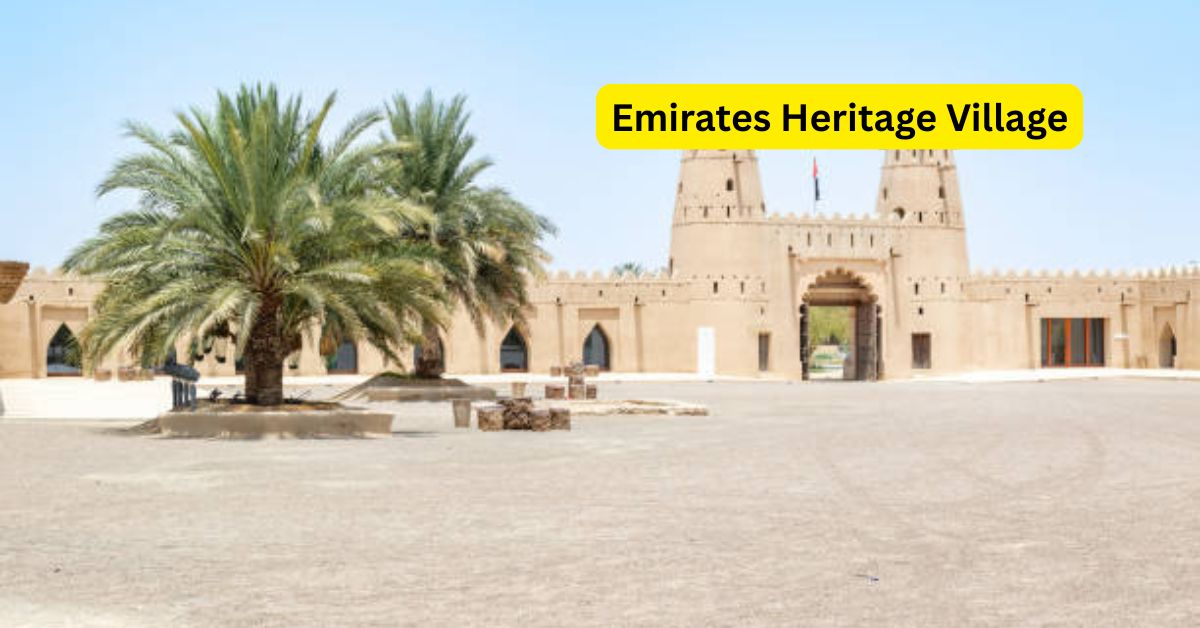
Emirates Heritage Village in Abu Dhabi is a living window into the UAE’s rich past. Located on the scenic breakwater, this cultural attraction lets you step back in time and experience traditional Emirati life before oil was discovered. As you walk through the village, you’ll see mud-brick houses, wind towers, and shaded courtyards that reflect old architectural styles. Local artisans demonstrate age-old crafts, such as pottery-making and basket weaving, while market stalls display fragrant spices like saffron, cumin, and frankincense. With free entry, camel rides, and a calm atmosphere under palm trees, Emirates Heritage Village is an ideal place to explore history, culture, and authentic traditions in Abu Dhabi.
Quick Facts
| Attribute | Details |
| Location | Breakwater Road, Corniche (near Marina Mall), Abu Dhabi |
| Established | 1997 (opened by decree of Sheikh Zayed bin Sultan Al Nahyan) |
| Managed by | Emirates Heritage Club (part of Abu Dhabi’s Culture Department) |
| Entry Fee | Free (no ticket needed) |
| Hours (Sun–Thu) | 9:00 AM – 4:00 PM |
| Hours (Friday) | 7:30 AM–12:00 PM & 3:00 PM–9:00 PM |
| Address | Abu Dhabi Theatre Rd, near Marina Mall |
History of Emirates Heritage Village
The idea for the Emirates Heritage Village was Sheikh Zayed’s way of preserving Emirati culture. He wanted people to remember the old way of life in the desert before oil was found. Sheikh Zayed bin Sultan Al Nahyan made it a reality in 1997. The village began as a small collection of tents but has since grown into a large site full of historical events and modules. It contains huts made of palm leaves and coral-stone mosques from the past, and even a special water channel that illustrates how water was used in the desert. The Heritage Village is essential in helping us see how skyscrapers in the UAE stand out and why the country still takes pride in its Bedouin past, as Sheikh Zayed wanted.
What to See at the Heritage Village
A traditional Emirati house—complete with a windtower and a white-domed mosque—is that real old desert building that looks really old. At the craft place, where people make things, visitors can walk through the space. By following these possible scenarios, you might come across a potter at the wheel shaping his clay, a blacksmith hammering out a horseshoe, and people endlessly at the loom. You can take a walk and station yourself at the rest areas or under the shade where you are comfortable, taking pictures, including camels.
Traditional Market (Souk)
Move slowly through woven lanes, which are covered on all sides by sellers of perfumes and dried fruits, honey, and the like, the aroma of spices is just beyond, and of course, the aroma of the coffee is quite pleasant too. The bazaars are all on the left, and the right parts are the places where you can find only locally made goods. The street from the mosque is made of petals of roses. They continually fall to their knees, and as they smoke incense sticks, the scent of incense fills the souk. It is as if you were carried back in time. The gates, when the gates of the city were all made in the same Arab style, with importing points of view from Middle Eastern cars th, which were full of fruits and other goods from other cities.
Craft Workshops
Witness a long-forgotten tradition of using modern technology available today that allows no creativity to be wasted. The process of creation is not only about potters making clay jars and others weaving carpets, but also about glassblowing, turning glass into shapes, and metalworking into a new baking tray. These are the ways that artisans develop today, which resemble the ways they were done in the old days.
Bedouin Camp
The place looks like a real Bedouin camp, with palm-leaf cones on which they write “welcome.” In the background, a camel stands near the falconry tools, and between them, you can see a reed boat. You will also learn how indigenous people lived in these areas in the past and how skilled they were, although sending money over the internet was an enigma to them.
Heritage Museum
The fire that burns in the hearth and the dancing of the flame on the walls as if it is trying to escape is because of the dry wooden logs. One of them went up in flames when I was trying to light it. These olden things show even more of the past, what things are, and why we have them.
Palm-Frond Mosque
A mosque that is formed from palm leaves, coral stones, and mud bricks. You can marvel at the superb craftsmanship of the two early inhabitants, and at the same time, you can study the uncomplicated style of the building.
Visitor Information
As for the practical details, the Abu Dhabi Heritage Village timings are clearly listed on official sites: the village is open 9:00 AM–4:00 PM daily (Sunday through Thursday). On Fridays, the hours are split into morning (7:30 AM–12:00 PM) and evening (3:00 PM–9:00 PM) sessions. Generally, here there is enough time, and one can choose when to be there with fewer people, their off-peak hours. Very much so: the Emirates Heritage Village tickets are not needed; egress to the beach is open to all without charge. In conformity with that, be at the gates during opening hours. The official Emirates Heritage Village is located on Breakwater Road (Abu Dhabi Theatre Rd), near Marina Mall, right on the Corniche. The entrance is right at the Marina Mall. Take a taxi or a bus along the Corniche and get off at the one-minute walk entrance.
Opening Hours
| Day | Opening Hours | Admission |
| Sunday–Thursday | 9:00 AM – 4:00 PM | Free |
| Friday (morning) | 7:30 AM – 12:00 PM | Free |
| Friday (evening) | 3:00 PM – 9:00 PM | Free |
| Saturday | 9:00 AM – 4:00 PM | Free |
Nearby Attractions and Tours
Sheikh Zayed Grand Mosque
An immense, white mosque discovered on the right side of the road toward the hotel is merely 15 minutes by car. It is extensive and impressive, although different from the plain Heritage Village.
Qasr Al Watan
A luxurious palace that is near the Corniche. First, you can visit its extraordinary chambers and the beautifully laid-out garden, then visit the village to hear some old stories and traditions.
Emirates Palace
A well-known hotel with a gold-colored roof, approximately 10 minutes from the old town. Without a room in the hotel, you can still take time to look at the spotless lobby or have a casual coffee, if you have already been to the village.
Heritage Village (Dubai)
Make sure you don’t mix them up! Dubai also has its own Heritage Village, which reflects Bedouin life through traditional markets and hotels. History buffs may be able to visit both places to understand the past.
Desert Safari Dubai
If you visit Dubai, you should take part in a desert safari in the evening. It follows the course as the coaster car speeds through the sand, and you can witness the camels, and the experience can seem scary. A whole day doing the village and the Grand Mosque, and pursuing some fun at a desert safari later.
One of the good things about the Corniche is that you can do several things in Abu Dhabi. You can, therefore, do other things after the village, such as shopping downtown, taking a yacht ride, or strolling on the beach.
Final Thoughts
The Emirates Heritage Village is among the great tourist spots of Abu Dhabi that throw light on culture. Admission is easy, and some attendants make you handle the instruments and devices. It is attractive to families and to tourists who want to learn. The first option could be spending 1 to 2 hours getting to know the present before going to the following entertainment site. The town is very convenient for reaching other places, as one book says about travel, so it is an ideal option for discovering the city. The Heritage Village is a time-tested place for taking some of your most incredible shots in the United Arab Emirates.