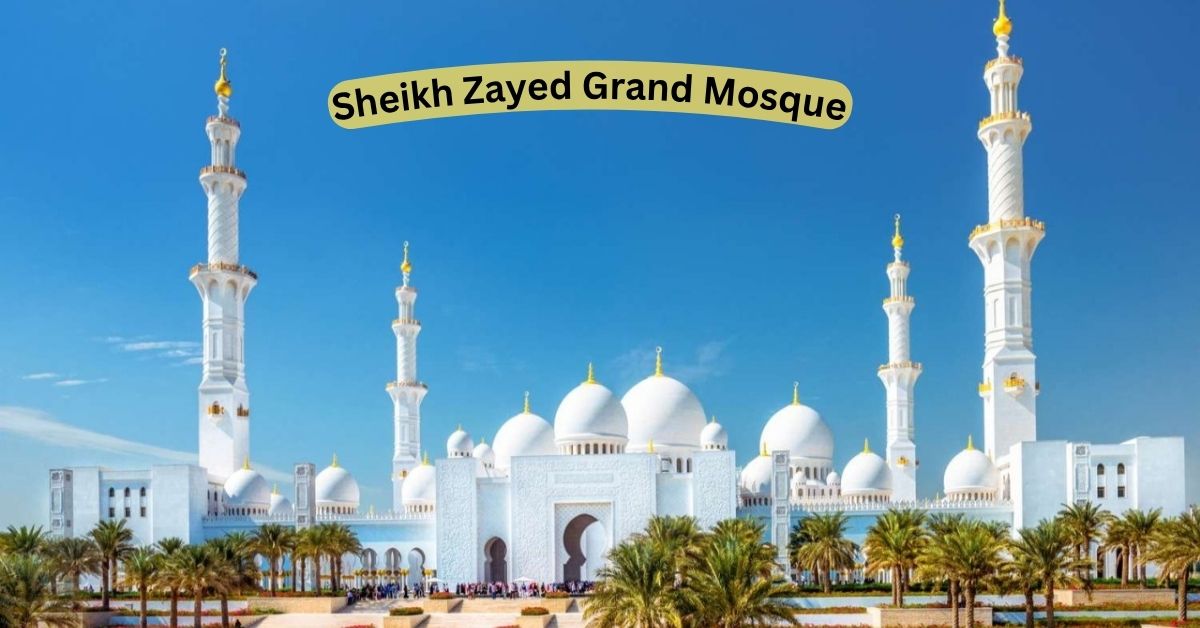
Abu Dhabi holds many surprises for first-time visitors, but nothing prepares you for that initial glimpse of the Sheikh Zayed Grand Mosque glowing white against the desert sky. It doesn’t just stand there — it commands the horizon. This isn’t simply a building. It’s a declaration: that beauty can carry meaning, that architecture can speak across faiths, and that one man’s dream can outlive him by generations. Every year, more than 6.8 million guests pass through its gates, making it the most visited cultural landmark in the entire UAE.
The Dream That Became a Landmark
One Man’s Vision for the Whole World
The story of this mosque begins with Sheikh Zayed bin Sultan Al Nahyan, the founding father of the United Arab Emirates and a man who spent his presidency building bridges between cultures rather than walls between them. He envisioned a sacred space that would embody Islamic tolerance and moderation — a place where worshippers and visitors of every background could arrive as strangers and leave with understanding. That ambition shaped every brick, dome, and carpet thread in the building.
Planning began quietly in the late 1980s, long before the UAE had established itself as a global destination. Construction officially commenced on November 5, 1996, and the project consumed eleven years of labor, bringing together over 3,000 workers from fifteen countries and thirty-eight contracting companies. Tragically, Sheikh Zayed never saw his dream completed. He passed away in November 2004 and was laid to rest in the mosque’s courtyard, just three years before the building opened its doors on December 20, 2007. Today his tomb rests beneath the open sky in the very place he imagined for the world.
The Architect Behind the Structure
Syrian architect Youssef Abdelke led the design, working alongside three fellow Syrian designers — Basem Barghouti, Moataz Al-Halabi, and Imad Malas — who developed and refined the plans over the construction period. Abdelke drew architectural inspiration from a wide arc of Islamic history. The grand dome layout and floor plan mirror the Mughal-era Badshahi Mosque in Lahore, Pakistan, once the largest mosque on earth. The horseshoe-shaped archways carry obvious Moorish heritage, echoing the grand monuments of Andalusia. The minarets follow classical Arab proportions, while decorative details pull from Persian traditions. British artist Kevin Dean was brought in specifically to design the courtyard’s extraordinary floral mosaic — selecting flowers native to the Middle East, including tulips, lilies, and irises, and recreating them in colored marble that spirals toward the center of each panel.
The construction supervision in its initial phase was handled by the Halcrow Group from the United Kingdom, and the final phase was completed through a joint venture involving Belgian construction giant BESIX Group. The total cost reached approximately 2 billion UAE dirhams — roughly 545 million US dollars.
Architecture That Refuses to Be Summarized
Numbers That Barely Tell the Story
The complex covers more than 555,000 square meters of total grounds, with the built structure itself spanning 290 by 420 meters across 12 hectares. It sits on elevated land rising about 10 meters above its surroundings, visible from all three bridges connecting Abu Dhabi Island to the mainland. The building’s central axis is angled precisely 12 degrees south of true west, aligning the prayer halls toward the Kaaba in Mecca with mathematical exactness.
Eighty-two domes of seven different sizes crown the structure. The largest, centered above the main prayer hall, soars to 84 meters in height and spans 32.6 meters in diameter. Windows positioned at the base of each dome allow natural desert light to filter down into the prayer spaces below, shifting throughout the day in ways that no artificial lighting system could replicate. The interior of every dome is adorned with traditional Moroccan plasterwork crafted in glass-reinforced gypsum, layered with verses from the Holy Quran inscribed in Naskhi, Thuluth, and Kufic calligraphy scripts.
The Four Minarets and What They Represent
Rising at each corner of the central courtyard, the four minarets climb to approximately 107 meters — among the tallest in the world. Their design moves through three distinct architectural traditions as the eye travels upward: a square Arab base transitions to a Mamlukian octagonal middle section, which then gives way to a cylindrical top crowned with golden crescent finials made of gilded glass mosaic. Each minaret isn’t just decorative height — it’s a vertical journey through Islamic architectural history compressed into a single tower.
The exterior cladding across the minarets and the entire mosque uses Sivec marble from the quarries of Prilep in North Macedonia — a stone with origins in Roman antiquity, selected specifically for its radiant, near-luminous whiteness. The internal elevations use Lasa marble from South Tyrol in Italy, while the annexes and offices draw on the renowned Makrana marble from Rajasthan, India — the very same stone used in the construction of the Taj Mahal.
What Is Special About the Sheikh Zayed Grand Mosque
The World Record No One Expected
Walk into the main prayer hall and the first thing that arrests your attention isn’t the chandeliers overhead — it’s the floor beneath your feet. The world’s largest hand-knotted carpet stretches 5,627 square meters across the entire hall. Iranian artist Ali Khaliqi designed it, and around 1,200 artisans from Iran’s Khorasan province spent approximately two years knotting every thread by hand, tying roughly 2,268,000,000 individual knots into wool sourced from New Zealand and Iran. The finished carpet weighs 35 tons and was transported to Abu Dhabi in nine sections, then assembled on-site by the artisans themselves. It holds a Guinness World Record certification, though the experience of walking on it barefoot — which the mosque requires — makes the statistics feel inadequate.
Chandeliers Built Like Architecture
Seven chandeliers hang from the main prayer hall ceiling, all manufactured by the German company Faustig in Munich. The framework of each chandelier is constructed from stainless steel gilded with 24-carat gold, then encrusted with millions of Swarovski crystals arranged in patterns that deliberately mirror the medallion designs of the carpet below. Look up, and the circular arabesque at the center of the largest chandelier aligns visually with the central medallion on the floor — a design relationship that only reveals itself when you know to look for it.
The principal chandelier measures 12 meters in diameter, stands 15.5 meters tall, contains 15,500 LEDs, and weighs 12 tons. Remarkably, it contains an internal spiral staircase built purely for maintenance access — a piece of hidden engineering inside a piece of art. The chandelier is recognized as the third largest in the world overall, and the largest inside any mosque.
The Courtyard and Its Marble Canvas
The central courtyard, known as the Sahan, covers 17,000 square meters and holds the title of the largest marble mosaic in the world. During Ramadan and Eid, it accommodates up to 31,000 worshippers under the open sky. The floral mosaic beneath everyone’s feet incorporates semi-precious stones — lapis lazuli, carnelian, and amethyst — inlaid into white marble using ancient Pietra Dura craftsmanship, the same stone-marquetry technique used by Mughal artisans on the Taj Mahal. Seven reflective pools run along the mosque’s arcades, creating mirror images of the domes and columns that shift and ripple with wind and light throughout the day.
What’s Inside the Grand Mosque
The Main Prayer Hall’s Sacred Details
The main prayer hall accommodates approximately 7,800 worshippers and is flanked by two additional halls — one for men and one for women — each holding 1,500. The 96 interior columns are clad in white marble and inlaid entirely with mother of pearl, a rare and extraordinarily labor-intensive technique found in very few sacred buildings anywhere on earth. The 1,096 exterior columns that line the arcade are decorated using Pietra Dura floral inlay with lapis lazuli, red agate, and amethyst, their pilasters shaped to suggest the drooping fronds of date palm trees.
The Qibla wall — the wall facing Mecca, toward which worshippers direct their prayers — is finished in premium Italian Aquabianca and Bianco P marble and carries all 99 Names of Allah inscribed in Kufic calligraphy by UAE calligrapher Mohammed Mandi Al Tamimi. Subtle fibre-optic lighting is embedded within the design, creating a quiet luminescence that makes the calligraphy appear to glow from within. At the center of the Qibla wall sits the Mihrab, a semi-circular niche marking the prayer direction, with an eleven-step Minbar carved from American cedar and inlaid with white gold, mother of pearl, and glass mosaic.
The Library Inside a Minaret
The mosque contains something genuinely unique in the world: a functioning library housed inside a minaret. Located in the northeast minaret, the Sheikh Zayed Grand Mosque Centre’s library holds rare manuscripts and publications covering Islamic sciences, civilization, art, calligraphy, and numismatics. The collection spans Arabic, English, French, Italian, Spanish, German, and Korean — a quiet reflection of the mosque’s founding philosophy that knowledge, like the building itself, should welcome everyone.
The Lunar Lighting System
After sunset, the mosque undergoes a complete transformation. A custom lighting architecture designed by the British firm Speirs and Major Associates projects shifting gradients of blue and white across the white marble exterior, cycling through fourteen distinct shades in a sequence timed to follow the phases of the moon. On a full moon night, the projection reaches its brightest intensity. On the nights of a new moon, it dims to its quietest. The reflective pools amplify everything, turning the courtyard into a doubled image of sky and stone. This system is unique — no other mosque in the world operates a lighting scheme calibrated to lunar astronomy.
Is Sheikh Zayed Mosque Free to Enter
Admission and Practical Access
The answer is simply yes. Entry carries no fee whatsoever for any visitor regardless of nationality, faith, or background. This policy was built into the mosque’s founding philosophy and has never changed. Guided cultural tours conducted by trained SZGMC specialists are also provided free of charge, running throughout the day in Arabic, English, Hindi, Urdu, French, German, Spanish, and several other languages. Tours last between 45 and 60 minutes, depart from the eastern entrance, and cover architectural history, Islamic traditions, craftsmanship details, and cultural context.
Audio guides in 13 languages are available with a refundable ID deposit. A premium Private Cultural Tour option exists for those who want a dedicated specialist, golf cart transport, and access to exclusive areas — this carries a fee and requires advance booking through the official SZGMC website.
Visiting Hours and the Friday Rule
The mosque is open Saturday through Thursday from 9:00 AM to 10:00 PM, with last admission at 9:30 PM. On Fridays, visiting hours run from 9:00 AM to 12:00 PM, then reopen at 3:00 PM and continue until 10:00 PM. During Ramadan, hours shift significantly — the first twenty days see the mosque open from 10:00 AM to 6:00 PM and again from 9:30 PM to 1:00 AM, with Friday hours adjusted accordingly. Visiting on the 27th night of Ramadan delivers a truly extraordinary experience — in 2025, that single night saw over 70,680 worshippers in attendance, surpassing the official 40,000-person capacity.
Dress Code and Visitor Etiquette
What to Wear and Why It Matters
The dress code at the mosque is firm and consistently enforced. Both men and women must cover arms and legs completely. For women, full-length, loose-fitting clothing is required along with a headscarf that covers all hair. The mosque provides free abayas and headscarves at the entrance for visitors who arrive without appropriate attire — so there’s genuinely no excuse for turning up unprepared. Men need long trousers extending to the ankle and shirts with sleeves reaching at least to the elbow. Tight, transparent, or figure-revealing clothing will result in being redirected before entry. Shoes must be removed before stepping onto carpeted areas inside the prayer halls.
Beyond clothing, the etiquette is about presence and awareness. Keep voices low. Don’t touch decorative surfaces or carved elements. Follow the designated visitor paths. Photography is permitted in exterior areas, the courtyard, and most interior zones during visiting hours, but should be set aside during active prayer times. Photographing worshippers without clear permission is not acceptable.
Getting There
The mosque is located at Sheikh Zayed Grand Mosque Centre on Sheikh Rashid Bin Saeed Street, Abu Dhabi. Taxis from Abu Dhabi city center take around 20 to 30 minutes. Public buses — routes 094, 24, and 161 — stop nearby for a fraction of the taxi fare. Free on-site parking with over 3,000 spaces serves those arriving by car. From Dubai, the journey takes roughly 90 minutes by road. A free shuttle service (Bus Route 8) also operates from Abu Dhabi Airport Stop 27 directly to the mosque entrance.
Conclusion
The Sheikh Zayed Grand Mosque stands as far more than an architectural achievement — it’s a functioning embodiment of a philosophy. Sheikh Zayed believed that beauty dissolves barriers, that a building open to all peoples reflects the deepest values of Islam, and that culture shared becomes culture understood. The records it holds — the carpet, the mosaic, the lunar lighting, the minaret library — are not trophies. They are expressions of that belief made permanent in marble, crystal, and light. Whether you arrive at sunrise when the white marble turns gold, or at midnight when the moon-phase lighting shifts through deep blue, the mosque rewards attention with something that doesn’t fit neatly into a photograph. Come with time, come with patience, and come prepared to be genuinely moved.
Frequently Asked Questions
Is entry to the Sheikh Zayed Grand Mosque free for all visitors?
Yes, admission is completely free for everyone. No tickets are required, and there is no fee for standard guided tours. The mosque’s open-door policy applies to all nationalities and religious backgrounds without exception, in direct accordance with Sheikh Zayed’s founding vision.
What is inside the Grand Mosque that makes it world-famous?
The main prayer hall houses the world’s largest hand-knotted carpet at 5,627 square meters and seven Swarovski crystal chandeliers, the largest of which is 12 meters wide and 15.5 meters tall. The 96 interior columns are inlaid with mother of pearl, and the Qibla wall carries all 99 Names of Allah in Kufic calligraphy with embedded fibre-optic lighting. The courtyard contains the world’s largest marble mosaic, and the building operates a one-of-a-kind lunar lighting system after dark.
Is the Sheikh Zayed Grand Mosque open to non-Muslims?
Absolutely. The mosque was designed from the beginning as a place of welcome for people of all faiths and backgrounds. Non-Muslim visitors are received warmly, guided tours are specifically designed to educate and inform visitors of all beliefs, and there are no restrictions on entry based on religion.
What is the dress code for visiting?
Both men and women must cover their arms and legs fully. Women are additionally required to cover their hair with a headscarf or hijab. Free abayas and headscarves are provided at the entrance for those who need them. Tight or transparent clothing, shorts, and sleeveless tops are not permitted. Shoes must be removed before entering the main carpeted prayer hall.
What are the visiting hours and when is the best time to go?
The mosque is open Saturday to Thursday from 9:00 AM to 10:00 PM. On Fridays it closes at 12:00 PM and reopens at 3:00 PM. The best times for photography are early morning just after opening, or in the evening after sunset when the lunar lighting system activates. The winter months from November through March offer the most comfortable outdoor temperatures for extended visits.